
Case Study: Have Payback Periods Risen for Self-Consumption PV systems in Peninsular Malaysia?


IEN Consultants recently performed a photovoltaic (PV) system feasibility study for a 2-story shopping centre + warehouse building in Kuala Lumpur Malaysia, henceforth referred to as ‘Building X’. While the initial objective of the study was to evaluate the feasibility of different surface areas of the building (including the vertical façade) for PV adoption, some other interesting findings presented themselves at a very early stage. Most glaringly – the payback period (i.e the amount of time needed for the system to pay back its upfront cost and start generating a profit), was found to be approximately 8 years.
For some context, PV systems of this size and nature in Malaysia have historically been estimated to have a payback period closer to 3 to 4 years. So, what has changed in this case? The answer lies in several major developments within the last 2 years in Peninsular Malaysia:
July 2025: Restructuring of TNB’s electricity tariff charges (RP4)
January 2026: Suruhanjaya Tenaga (ST) regulations mandating the use of Battery Energy Storage Systems (BESS) on self-consumption (SELCO) PV systems > 1MWac come into effect.
January 2026: Suruhanjaya Tenaga (ST) regulations implementing a standby charge of RM12/kWp on self-consumption (SELCO) PV systems > 1MWac come into effect
To demonstrate the effect these developments have had on a project like Building X, we performed a comparison between 3 scenarios. Each scenario used the exact same PV system with identical annual generation, with the only difference being the time at which the system would have been built, and by extension, the tariff rates and regulatory requirements required at each point in time:
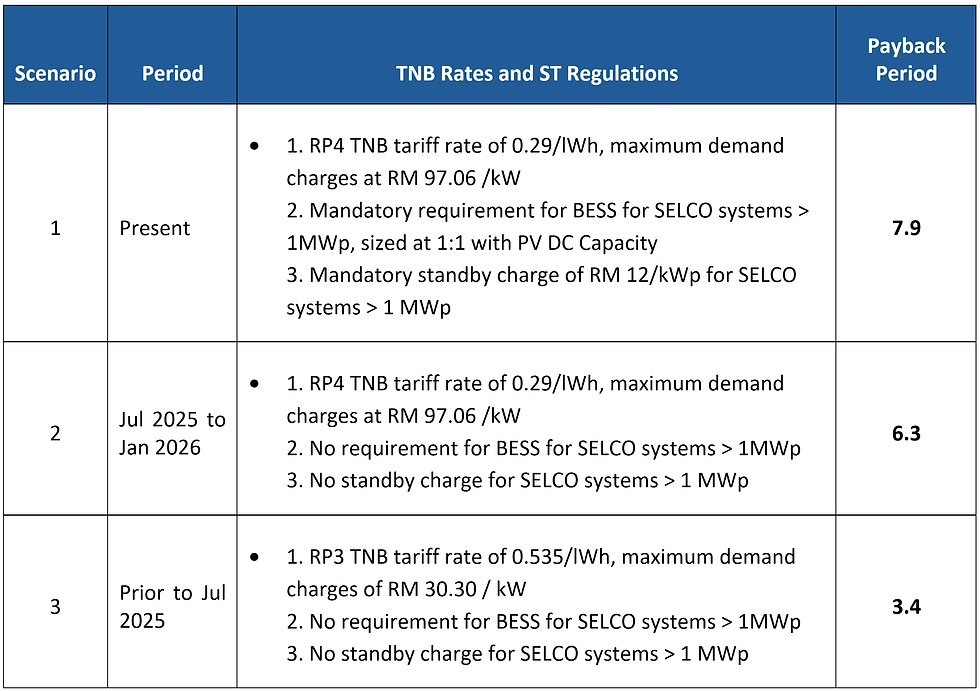
1: ST amended the BESS requirements in March 2025 to only be required for systems above 1MWac and adjusted the standby charge to RM 12 / kWp for systems above 1MWac. These requirements were differed until 31 December 2025.
2: A BESS Requirement and standby charges pf RM 14 / kWp was initially announced to be implemented in January 2025 for systems above 72 kWp. However, due to strong industry pushback this was not enforced.
The results speak for themselves, showing that since 2025, the payback period for projects like Building X has more than doubled. Now that the overall picture has been established, we take a closer look at how exactly these changes have had such a drastic effect on financial feasibility in projects such as ours.
Before we go further, however, some basic information on the system in question:

Photovoltaic System key design parameters:
DC Capacity: 3,843 kWp
AC Capacity: 2,956 kWp
Annual Irradiation: 1,439 kWh/m2
Annual Specific Yield (kWh/kWp/year): 1,151 kWh/kWp/year
Total Capital Expenditure of System (CAPEX): RM11,212,097, or RM2,917 / kWp
For those reasonably well versed in rooftop PV systems, these numbers are very typical for a system in Malaysia and would very much be in line with the aforementioned 3–5-year payback period that one would expect. So, if there is no issue with the system generation, we turn towards the first culprit:
Restructuring of TNB electricity tariff changes
The building we studied was a Medium Voltage (MV) consumer that had switched to the latest RP4 Time of Use (TOU) tariff scheme under TNB starting July 2025. Prior to this, it had been under the RP3 tariff scheme. For our study, we did not include Automatic Fuel Adjustment (AFA) rates under the RP4 tariff, due to the fluctuation between negative and positive values within the last year. For the RP3 tariff Imbalance Cost Pass-Through (ICPT) charges for MV consumers were estimated to be 17 sen/kWh, which was the rate pre-July 2025.
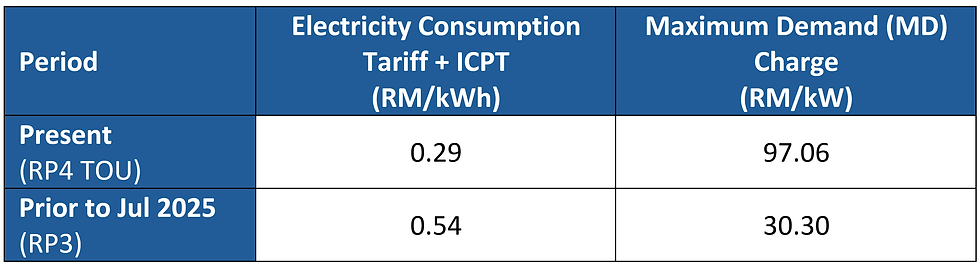
Here is a visual representation of how the composition of this particular building’s monthly electricity bill has significantly changed since the 2025 revision of the TNB tariffs.
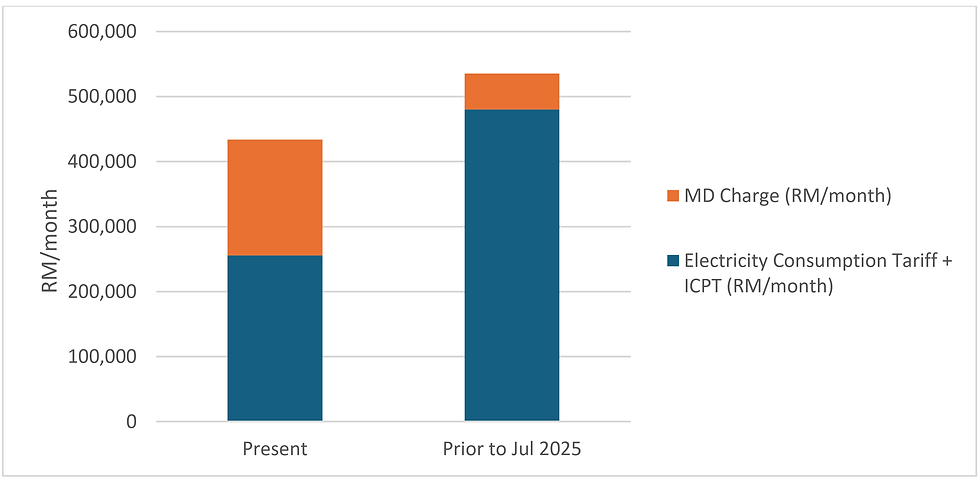
At face value, we see a slight reduction in the building’s overall monthly energy bill since switching over to RP4. However, the percentage of the overall bill attributed to MD charges has increased drastically, from about 10% to 40% of the overall bill. The MD charge is a fixed charge that is applied to the peak energy consumption (kW) at its single highest instance that month.
This added emphasis on the MD charge, and lower energy consumption charges has actually reduced the potential energy savings from PV generation from a pure energy replacement perspective. The graph below shows the load profile before and after PV generation for a typical day in Building X and illustrates how reduced energy consumption charges and higher MD charges reduce cost savings from PV generation.

In the case of Building X, the total monthly savings from energy generation at present would be RM 1,258,992. Prior to July 2025, this would have been almost double at approximately RM 2,366,942. Therefore, in the present scenario, achieving additional cost savings would also require the reduction of the MD, which also leads us to our next point..
The mandatory requirement for self-consumption (SELCO) projects exceeding 1MWac to install a Battery Energy Storage System (BESS)
Becoming effective in January 2026, Suruhanjaya Tenaga (Energy Commission) has mandated that any SELCO PV system exceeding 1MWac is required to install a BESS, sized at a 1 to 1 ratio to the system’s AC capacity.
Let us preface this by saying that a BESS makes sense and can be beneficial in specific use cases. Take, for example, a residential home, where all occupants are out of their homes for most of the day. The generated energy from the PV system can be stored in the BESS throughout the day and used at night when people are back home. You can refer IEN’s article ‘ROI Optimisation for Solar PV and Battery Systems’ on our website at https://www.ien.com.my/post/roi-optimisation-for-solar-pv-and-battery-system for more on BESS implementation and the benefits it can bring.
However, a BESS simply does not make sense for every building, and certainly not at a fixed sizing ratio of 1 to 1 with the AC capacity of the PV system. Building X has an extremely uniform daytime load profile that was consistently above the renewable energy generated throughout the day. Left as-is, this would mean the battery hardly charges, specifically only up to 2.4% for a single hour each day. The figure below shows the energy load profile of Building X on a typical day, overlaid with the PV generation), and BESS charge level, and illustrates clearly how redundant a battery of that size would be for this system.

However, since the building is now stuck with a BESS no one really wanted due to regulatory requirements, it might as well be utilised in other ways to get some additional savings. We therefore studied a ‘peak load shaving’ strategy, where the BESS draws energy from the grid during the night-time (at the off-peak rate), and discharges this gradually during the day to lower the overall maximum demand of the building. As discussed in the previous section, we now know a large percentage of the new electricity tariff is dependent on maximum demand, so this could be beneficial.
So, some good news. However, for projects such as ours with a very consistent maximum demand profile 7 days a week, the amount of reduction possible here is limited. Furthermore, since the MD charge levied by TNB is charged for the single-highest instance of demand per month, your savings are limited to the worst-performing day of the month. In other words, Building X could lower its maximum demand by 30% for 99% of days within a month, but a single case of a rainy day in the afternoon would reduce its PV generation, and by extension its MD reduction, to say, 15% instead. Taking this into consideration, we simulated this MD reduction on the worst performing day of a month, where PV generation was at 40% of its typical generation profile.
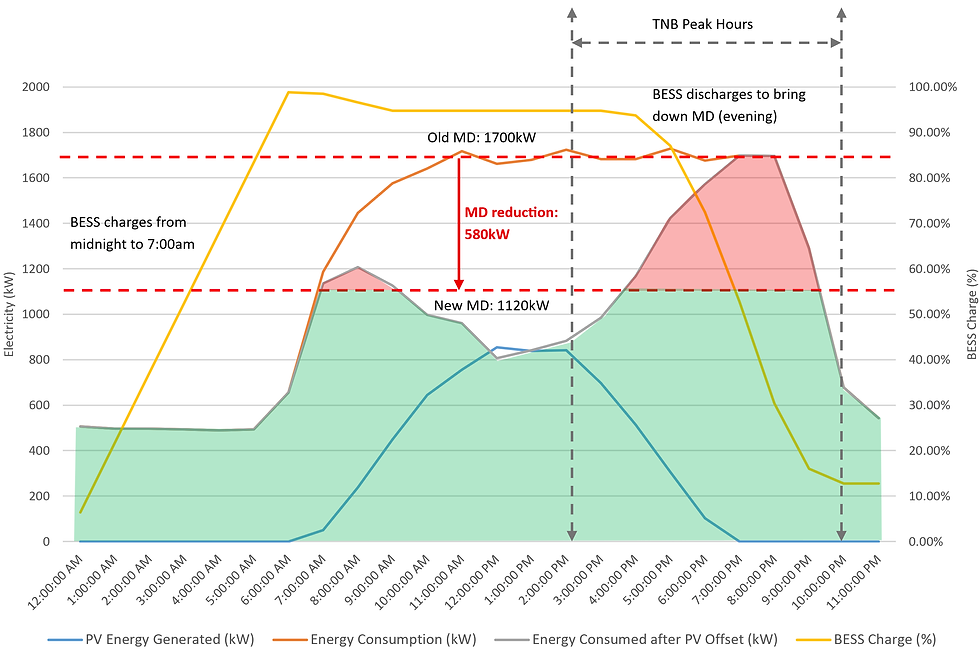
Based on our study, a MD reduction of 580kW was possible on the worst performing day of a month, which equates to savings of RM 673,586 monthly. In addition to this, a further RM 35,744 was saved monthly via the additional savings from the energy purchased at night to charge the BESS for daytime due to the difference between peak and off-peak charges.
However, just as things are looking up again..
The mandatory RM12 / kWp standby charge on SELCO projects exceeding 1MWac
As per Suruhanjaya Tenaga (Energy Commission)’s, latest guidelines, in addition to the BESS requirement, an additional standby charge of RM 12/kWp is imposed upon SELCO systems larger than 1MWac. This is a monthly charge included in the user’s monthly energy bill. According to the ST guidelines, this charge serves to “reflect the true cost of supply, ensure fairness to all consumers, and maintain the security and reliability of the electricity supply system”. We can infer that this is intended to cover the associated costs borne by TNB to maintain the grid infrastructure necessary to handle 100% of the facility’s power demand in the event of a solar drop out during the daytime, for example during maintenance or low irradiance days.
However, paired with the prior BESS requirement, this serves as a ‘double penalty’, given that the installed BESS is already performing the job of grid protection, which based on this standby charge, is implied to be a cost borne by TNB. Furthermore, basing this on installed nameplate (DC) capacity further disadvantages less-efficient systems such as vertical façade PV, or other building integrated PV (BIPV) technologies that we should currently be incentivising.
In the case of Building X, these standby charges came up to a whopping RM 553,352 per month. Unfortunately, what this means is that the savings we have managed to achieve via peak shaving and load shifting have been largely eliminated by this standby charge, and we are left with a net savings from the MD reduction and peak load shift of RM 155,977.
All in All …
With all of the above considered, we now return to the overall payback period comparison, in more detail:

It is important to clarify the results of our study do not apply to every building in Peninsular Malaysia. There may well be projects in which a full-sized BESS, employing peak shaving along with the new TNB tariff rates, that actually produces a better payback rate than pre-January 2026 / July 2025, even with the additional standby charge.
Setting aside the TNB tariff restructures, the critical issue here is the rigidity of the current ST regulations on BESS, and the ‘one-size fits all’ approach being taken. If the intent of mandating a BESS system for SELCO projects above 1MWac was to ensure zero export for grid stability, the BESS sizing requirement needs to be done on a case-by-case basis, to ensure that projects such as this, with little to no PV export to the grid are not unfairly mandated to install an incredibly oversized BESS.
Additionally, the standby charge of RM12/kWp should be re-evaluated as projects utilising BESS are already performing the job of grid protection by absorbing solar dropouts and smoothing ramp rates. For example, a full or partial standby charge exemption for BESS-equipped facilities would eliminate this ’double-charge’.
Malaysia’s 2023 National Energy Transition Roadmap (NETR) states an ambitious target of achieving net zero GHG emissions by 2050. Part of this roadmap involves achieving an installed renewable energy target of 50% (or 27GW of solar PV) by 2040, and 70% (or 57GW of solar PV by 2050). It also states that “The higher target is expected to generate new economic opportunities by attracting multinational companies, especially RE 100 companies, to operate in Malaysia.” If we as a country are indeed serious about meeting our renewable energy targets and are relying very heavily on private sectors to do so, the reality is that we need to be making renewable energy as financially appealing to building owners as possible. As it stands, the developments discussed in this article have sadly pushed things in the opposite direction.
Acknowledgements
IEN Consultants: Thank you to Gregers Reimann, Charles Loo and Mathilde Wölfle for their contributions to this article.
Cartoon illustration from: https://www.vecteezy.com/vector-art/74712395-confused-man-with-brown-hair-scratching-head-in-blue-jacket-cartoon-illustration


Comments