
Building with Living Banyan Trees

IEN were very inspired by the ongoing Hyperboloid Banyan project by Felix E. Klee, as well as his other references for living tree projects. This included photos of century old tree bridges in India and techniques from China and Europe of how to build with living trees. This type of project also poses an interesting time challenge. Not all clients are willing to wait several years or even decades for the trees to mature sufficiently to attain their design target. For example, a Banyan tree stretching across a river to form a walkable bridge is by no means a short-term project!

Building with living trees is a captivating concept, as it does not require cutting down any trees or using any resources. The biophilic element of ever changing trees is also fascinating. In fact, we felt so inspired that we undertook an internal brainstorming later the same day to explore in what ways we could use Banyan trees for projects in tropical Malaysia. We pretty quickly filled the whiteboard with eight different ideas:

Our 8 Baynan tree ideas were:
Banyan tree shaped to become a bridge across rivers
Banyan tree shaped to become an overhead pedestrian bridges across roads
Banyan tree shaped to provide shade (bus stop/pedestrian walk/city plaza tree)
Banyan tree shaped to become a Nature playground
Banyan tree shaped to become an outdoor classroom
Banyan tree shaped to become a 2-storey pavilion
Banyan tree shaped to become a carport
Banyan tree shaped to become a house extension (1st floor balcony/outdoor room/carport)
Our suggested approach is to first build the structure (e.g. a bridge) with another material (e.g. bamboo), so it becomes usable by people from day one. And for the Banyan tree to slowly overtake the structure over time.
We illustrated our Banyan tree ideas by feeding our whiteboard sketches into Gemini AI, which in no time created these beautiful pencil drawings:

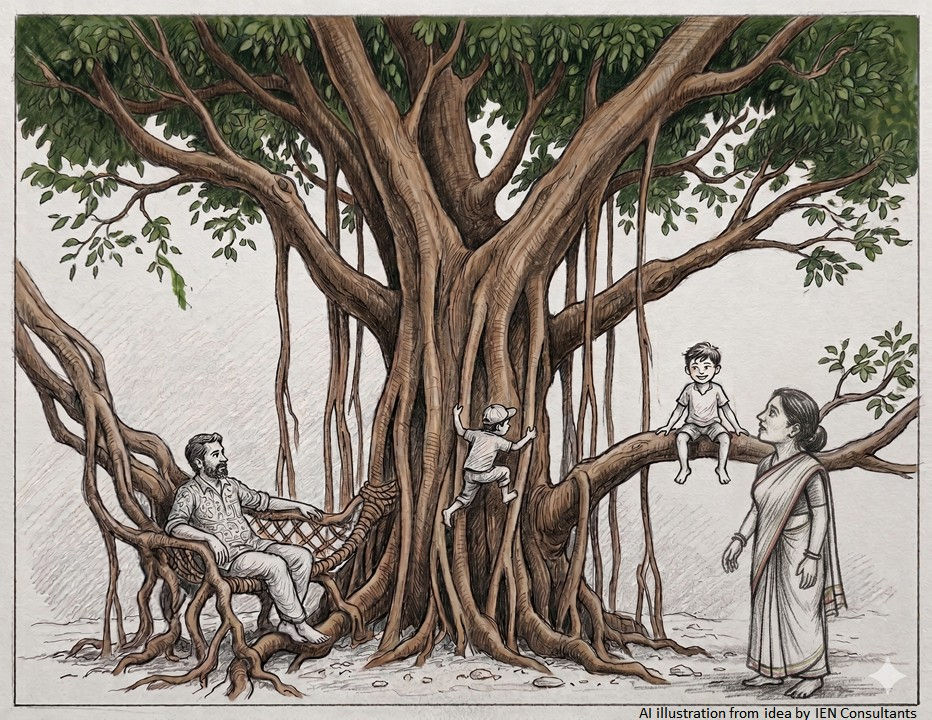

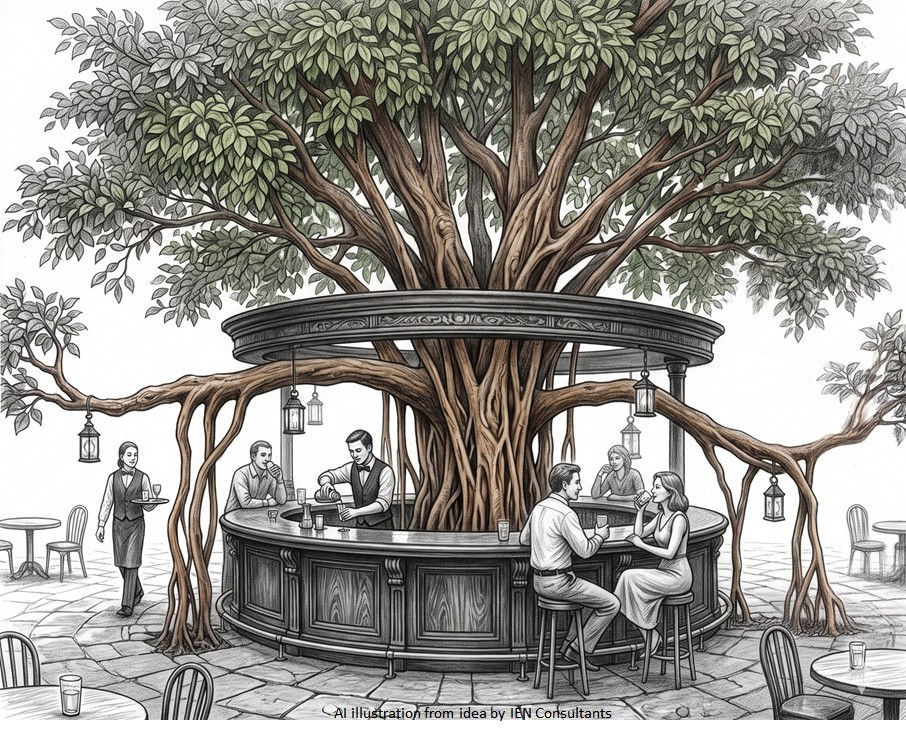
The process of creating nice illustrations from relatively simple hand sketches / stick figures was surprisingly easy with the use of artificial intelligence. Below we share the work flow of generating one such AI illustration on an existing photo:

The stricking image of a Banyan tree bridge across the Kerayong river just before entering the Klang River (Kuala Lumpur) was created in the first attempt. Notice how the stick figures were nicely illustrated with real people. On the hand sketch, different colours were used to illustrated different things, so the AI tool more easily could identify what is what. For example, the AI promt for creating the people was: "Replace the purple lines with people, one of them pushing a bicycle".
The above living bridge illustration is entirely realistic as real tree bridge projects already exist. See photo below of the Living Root Bridge in Meghalaya, India:


One of the first Banyan tree bridge sites in Kuala Lumpur could indeed be along the Klang river, were we thanks to our contacts with the people from the Klang River Festival became aware of an informal river crossing running parallel to the busy Old Klang road bridge. See our video documentation here and the Banyan tree river bridge presented in the last 20 seconds of the video:
Looking forward to exploring these inspirational and meaningful living tree project ideas further. Contact us at info @ ien.com.my
References & acknowledgements:
Thank you to Felix E. Klee for planting the inspiration idea of designing with live trees. Link to Felix's Hyperboloid Banyan webpage: https://hpr-ban.f76.eu/
Thank you to fellow IEN staff, Alia Meor, Christopher Richardson, Teddy Faubourg and Amelie Hottner, for an inspirational Banyan tree design brainstorming, which formed the basis for this article
Thank you to Faith Foo (Klang River Festival) and Elena Mei Yun (Bike with Elena) for giving the coordinates an photos of the informal river crossing at Sungei Kerayong near the Jalan Klang Lama (Old Klang Road)
Photos of living tree bridges in India sourced from this Treebo Club website: https://www.treebo.com/blog/living-root-bridges/


Comments