
Healthy Work Spaces - and a dead canary bird!

IEN was honoured to be invited to give a guest lecture at Universiti Malaya about the importance of Healthy Work Spaces. We shared the convincing economic case for designing / retrofitting buildings to have a conducive and stimulating indoor environments that allow people to thrive. And we share the following two of our case studies of buildings in Malaysia with good and healthy work spaces:
Paramit - factory in the forest This multi-award winning factory has gotten a very good feedback from occupants who love the working environment, which is literally like be emerged inside a forest. Every space has natural daylight and views out to greenery, and the factory was designed to have plenty of fresh air and comfortable temperatures. Our anonymous post-occupancy survey showed that what people most appreciated about the building was contact to Nature, the beautiful building design, and the conducive work environment.
Unilever Malaysia This office building went for double Gold certification for both WELL and LEED. The WELL certifications focusses entirely on the health and wellbeing of people. The LEED certification focuses more broadly on ensuring a low-environmental impact of buildings as well as on ensuring good indoor environments.
We have made our slides available for viewing / downloading here:
For this university lecture, we also brought along some measuring equipment including the illustrative and beautifully designed Birdie sensor. This sensor draws on the "canary in the coalmine" practise in the early days of coalminers, where the coalminers would used a live canary bird as an early warning system of bad air quality. Once the canary bird died, the coalminers would quickly vacate the mine, before dying themselves from dangerous gasses in the coal mine.
Unfortunately, the canary bird quickly died in the UM lecture room, presumably because the room has no or too little supply of outdoor air:
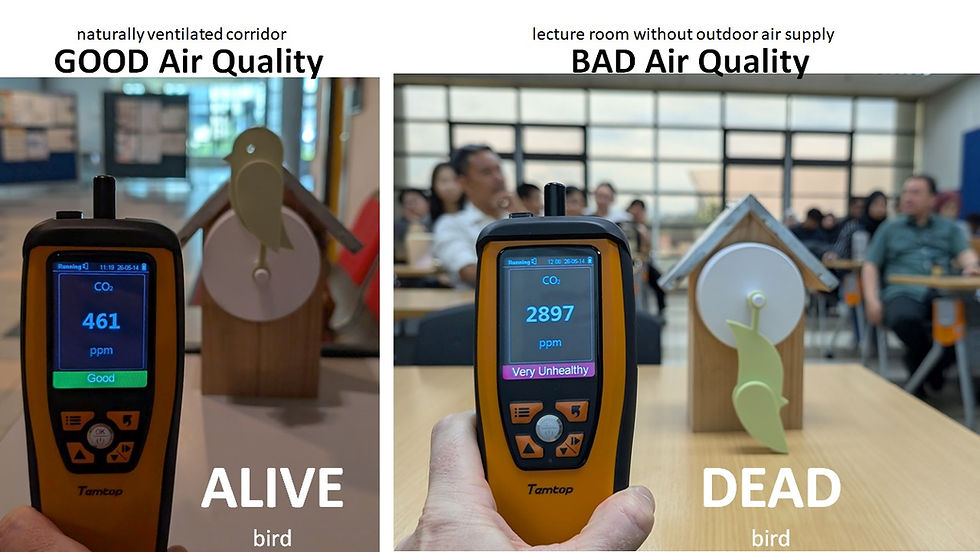
While the canary bird sensor does not show any measurement values, we brought along a separate CO2 sensor, which showed that the CO2 level of lecture room BK2, Level 3 (Mercu Alam Bina, UM) far exceeded the threshold of 1,000 ppm. In fact, we measured about 2,900 ppm of CO2, which is classified as "very unhealthy".
This measurement was an apt conclusion for our lecture on Healthy Work Spaces, showing the UM students and staff alike that there is great potential for improvements of the health in their immediate work spaces.
We, Annisa Ilias and Gregers Reimann, gave our guest lecture at Universiti Malaya to a total of 94 students and 4 lecturers, namely:
34 Year 3 Bachelor of Building Surveying
40 Year 2 Bachelor of Building Surveying
20 Year 2 Master of Facilities Management
4 lecturers
Many thanks to Dr. Mozhgan Samzadeh for inviting us to speak as well as to additional invitations to strengthen the collaboration between IEN and Universiti Malaya.
Photo gallary including from our cargobike bicycle ride from the IEN office (Bangsar) to Universiti Malaya:
UM Lecture Poster. The Future of Work. IEN and GreenRE as guest lecturers Healthy Work Spaces. Annisa Ilias before starting the UM guest lecture IEN's guest lecture at Universiti Malaya to about 100 students, some online Annisa Ilias giving her UM guest lecture on Healthy Work Spaces Gregers Reimann and Annisa Ilias with the Birdie CO2 sensor showing poor air quality Group photo after lecture at UM on Healthy Work Places Cargobike ride by Annisa Ilias and Gregers Reimann from IEN office to Universiti Malaya


Comments